
Vitamin C for Sensitive Skin: Why the Form You Use Matters
Vitamin C is one of the most researched and loved ingredients in skincare—and for good reason. It can help brighten uneven skin tone, defend against environmental stress, support collagen production and improve the appearance of post-inflammatory marks.
But if you have sensitive or rosacea-prone skin, you may have tried a vitamin C serum only to end up with burning, stinging, redness or irritation.
That doesn’t necessarily mean your skin can’t tolerate vitamin C.
It may mean you’re using the wrong form of it.
Not All Vitamin C Is the Same
When most people hear “vitamin C,” they think of L-ascorbic acid (LAA). It’s the pure, active form of vitamin C and is commonly formulated at concentrations of 10–20%.
It can be incredibly effective—but there’s a catch for sensitive skin.
L-ascorbic acid generally needs to be formulated at a low, acidic pH to remain effective and penetrate the skin. That acidity, combined with higher concentrations, can be difficult for already reactive or compromised skin to tolerate.
For someone dealing with rosacea, chronic redness or a weakened skin barrier, a powerful formula isn’t necessarily a better formula.
That’s one of the reasons I personally stay away from high-percentage L-ascorbic acid products.
Meet SAP: A Gentler Form of Vitamin C
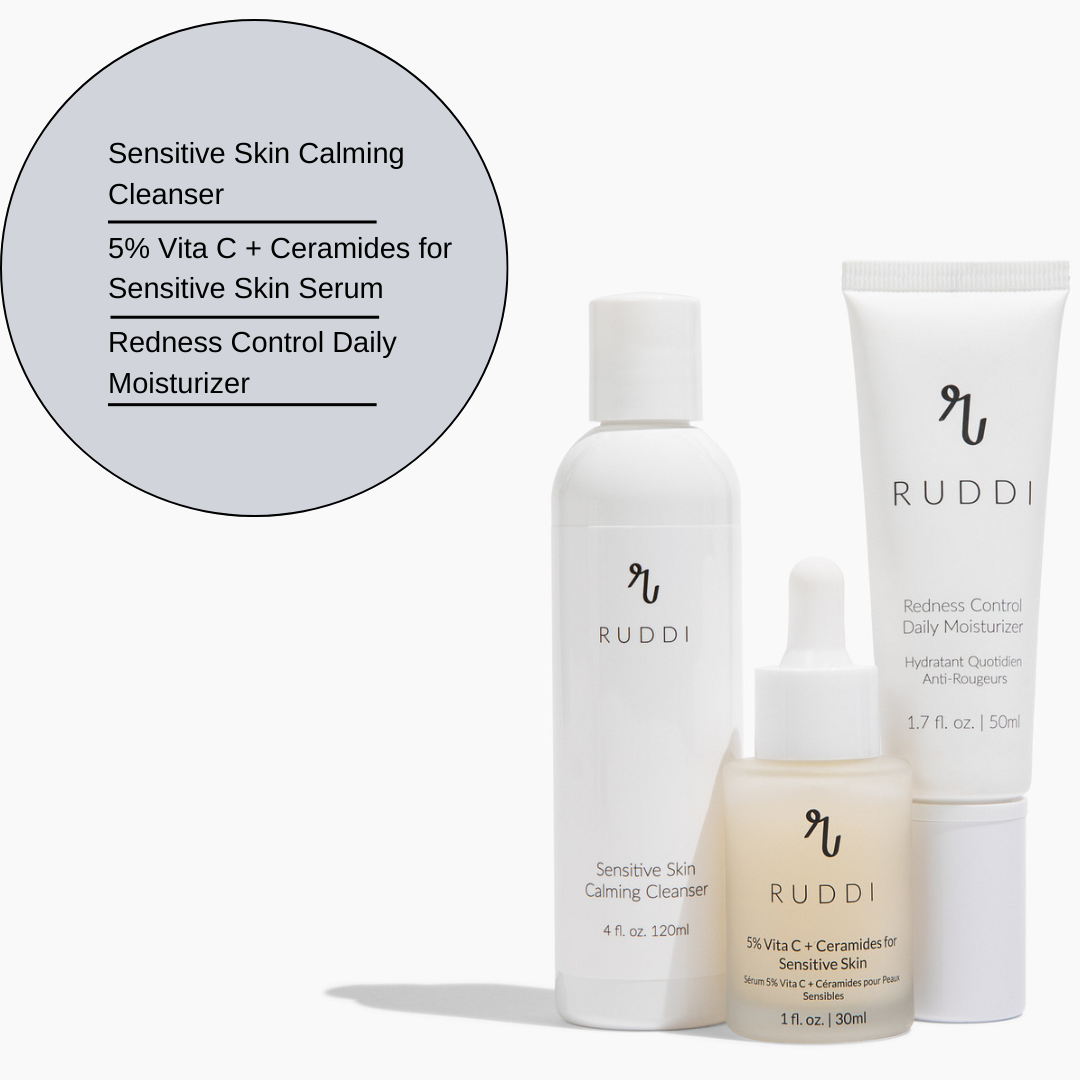
At RUDDI, we use 5% Sodium Ascorbyl Phosphate (SAP) in our Vita C + Ceramides Serum.
SAP is a stable, water-soluble vitamin C derivative that doesn’t require the same highly acidic environment as L-ascorbic acid.
That matters for sensitive skin.
Because SAP can be formulated closer to the skin’s natural pH, it tends to be much gentler and less irritating while still delivering meaningful antioxidant and brightening benefits.
And you don’t necessarily need 15% or 20% vitamin C to have an effective product.
More isn’t always better—especially when your goal is healthy, resilient skin.
At 5%, SAP can provide antioxidant support and help improve the appearance of uneven tone and post-inflammatory marks without unnecessarily overwhelming sensitive skin.
SAP has another interesting benefit: research has demonstrated antimicrobial activity, particularly against C. acnes, the bacteria associated with acne. That makes it an especially interesting form of vitamin C for skin experiencing both sensitivity and blemishes.
Which Vitamin C Should Sensitive Skin Be Cautious With?
This doesn’t mean L-ascorbic acid is a “bad” ingredient. For someone with resilient skin, a well-formulated LAA serum can be fantastic.
But sensitive and rosacea-prone skin often needs a different approach.
Be cautious with:
High-percentage L-ascorbic acid: Concentrations of 15–20% aren’t automatically more beneficial for sensitive skin and may increase the potential for irritation.
Very low-pH vitamin C formulas: The acidic environment required by traditional LAA formulas can cause stinging or discomfort, particularly when the skin barrier is already compromised.
Overly complicated vitamin C formulas: Strong exfoliating acids, fragrance, essential oils or multiple aggressive actives alongside vitamin C can make it difficult to determine what your skin is reacting to.
When choosing vitamin C for sensitive skin, I would look beyond the percentage on the front of the bottle.
Look at the form of vitamin C, the entire formula and what else the product is asking your skin to tolerate.
Why We Didn’t Stop at Vitamin C
When we formulated RUDDI’s Vita C Serum, I didn’t want to create another serum that focused solely on brightening.
For sensitive skin, antioxidant protection is only part of the picture.
The skin barrier needs support too.
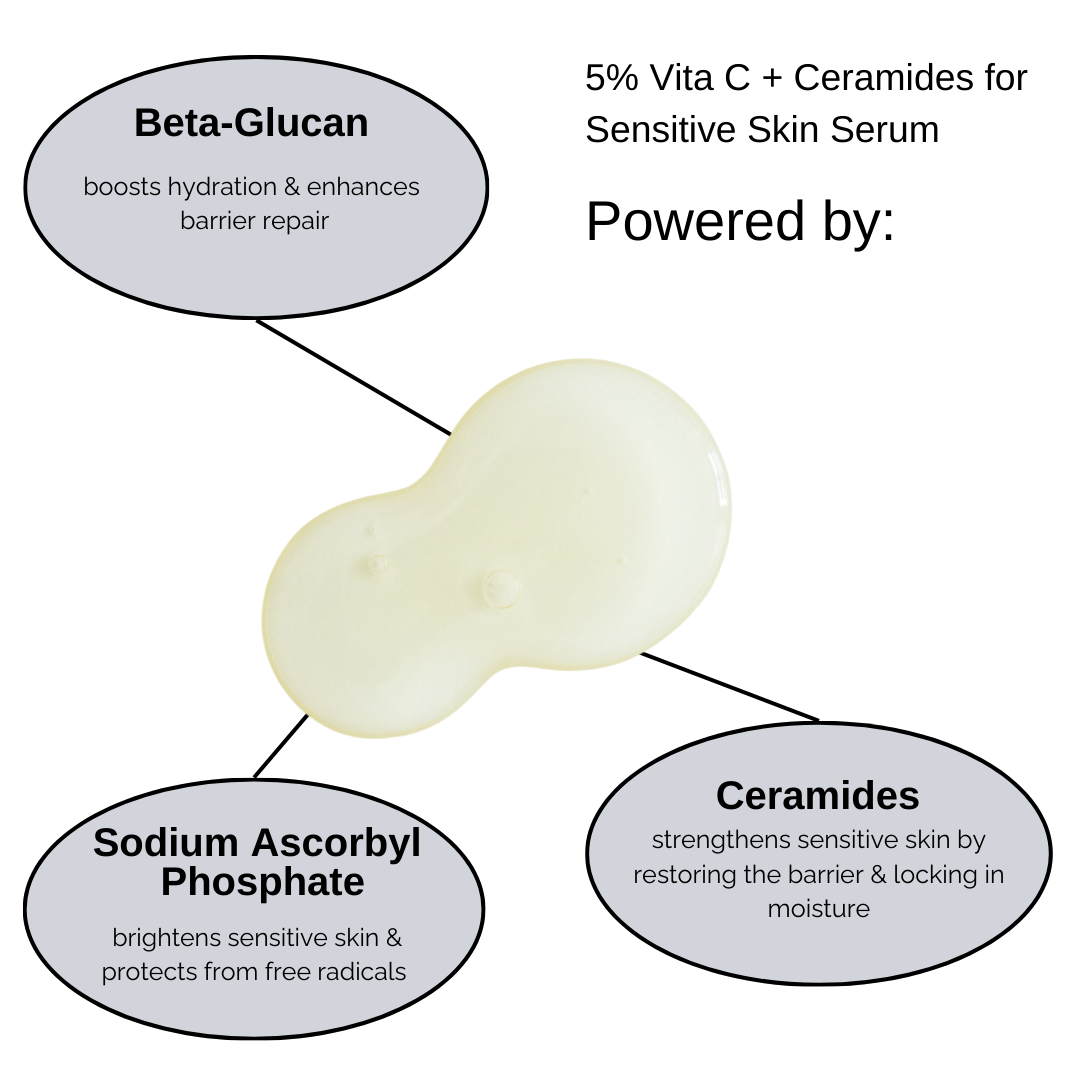
That’s why we paired 5% SAP with ceramides and beta-glucan.
And this is where the formula becomes especially powerful for sensitive skin.
Ceramides: Reinforcing Your Skin’s Barrier
Ceramides are lipids naturally found in the outermost layer of your skin. Think of them as part of the material that helps hold your skin barrier together.
When that barrier becomes compromised, skin can lose moisture more easily and become more vulnerable to external irritants.
Supporting the skin with ceramides can help reinforce that barrier and improve its ability to retain moisture—something that is particularly important for dry, sensitive and reactive skin.
Beta-Glucan: The Sensitive-Skin Multitasker
Beta-glucan is one of my favourite ingredients for sensitive skin.
It’s known for its soothing, hydrating and skin-supporting properties. It helps attract and retain moisture while supporting a calmer, more resilient skin environment.
For skin that frequently feels tight, dry, irritated or reactive, that additional soothing support can make a major difference in how a formula feels and performs.
SAP + Ceramides + Beta-Glucan = A Sensitive-Skin Powerhouse
This combination is intentional.
SAP provides antioxidant protection and helps brighten and improve uneven-looking skin.
Ceramides help support and reinforce the skin barrier.
Beta-glucan helps hydrate and soothe.
Instead of asking sensitive skin to tolerate an aggressive active in the name of results, we’re giving it antioxidant benefits while simultaneously supporting the barrier.
That’s the philosophy behind so many of our formulas at RUDDI:
Don’t fight your skin. Work with it.
You Don’t Need to Feel the Burn for Skincare to Work
There’s still a misconception in skincare that tingling, peeling or irritation somehow means a product is “working.”
For sensitive skin, I believe the opposite approach often makes more sense.
Consistency matters.
A beautifully formulated 5% vitamin C derivative that your skin can comfortably use every morning can ultimately be far more valuable than a 20% serum that leaves your skin irritated and sitting unused on your bathroom counter.
That’s exactly why we chose SAP.
Our 5% Vita C + Ceramides Serum was formulated specifically for sensitive, redness-prone skin—to deliver the benefits people want from vitamin C without treating irritation as the price of admission.
Because when you have sensitive skin, the goal isn’t to use the strongest skincare possible.
It’s to use effective skincare your skin actually loves.